We’ve all seen it before. That old line used to tell people that if they believe in themselves, they can do anything they want to do or be anything they want to be.

This really jumped out at me in my travels. It says in one what I’m trying to say in this post. Credit: George Helou
I don’t want to take away from this sentiment. After all, positivity is contagious, and many of us get by each day with fantasies at the forefront of our minds. For example, I would like to think that I have the potential to write a hit series. Chances are my writing isn’t that great. But it’s what I love doing, so I keep doing it. I fake being a hit novelist, so that in my own mind, I am happy.
Have you ever faked something? Chances are, unless you live under a rock, you will have faked something at some point in your life. There are many different types of fakers out there.
- The actor. This is the most common and acceptable form of faking. For some, this is a high paid job as they pretend to be somebody else in front of lots of cameras in a studio. For others, this means going to the office and politely helping angry clients. When they go home, they become a parent, child, a husband or a wife; another part they are playing.
- The change-about actor. The aspects of this faker are really just physical. They have different costumes for every occasion, mood and season. These people tend to wear heavy make-up and shudder at the idea of being caught out not looking attractive. While this actor comes across very vain, they suffer from low self-confidence and are merely making up for it in other ways.
- The try-hard. This faker fabricates aspects of their personality and even acts as a chameleon to get ahead in some way. In the school setting, this might be a girl desperate to be accepted into the popular clique. In the workplace setting, this might be an employee desperate to get that promotion from their boss.
- The attention seeker. This faker can go to one extreme or the other. They could be a Negative Nelly, or an eccentric who says and does shocking things for people to stay interested in them.
- The hypochondriac. This person appears to constantly be ill, or injured, and play it for all it is worth to gain sympathy.
- The one with no self-esteem. This faker also acts like a chameleon, and tends to be an outright liar, as they fake their way through social situations, pretending to like people they would happily never see again, just to climb up the social ladder and cover their insecurities about themselves.
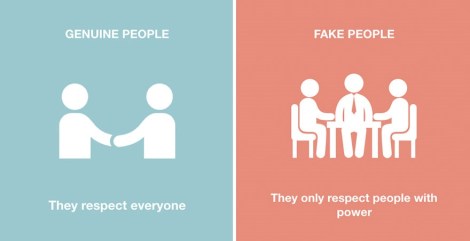 Say, for instance, you go out on a date with a really nice guy. You buy a fancy outfit that maxes out your credit card. This guy is a successful businessman with a six digit salary, who you desperately want to impress. So you turn up in a limousine, order the most expensive wine and steak, and talk about how you own your own business and live large. Eventually, he finds out that you are a retail assistant still living at home. Was it really worth it?
Chances are the people who do this are not bad people, but they do not love or respect themselves enough to take a moment to be honest with themselves and like themselves for who they really are. How can one tackle this issue though?
Here are just a few tips that can help you to open up to yourself and be selfless and truthful.
- Ask yourself: What are your values? What are the most important things in your life? Is it success? Money? Good health and love for your family? What are your worst fears? Dying alone? Losing your job? Having no friends? Write them down. Think about how much they have changed since you were young.
- Ask yourself: What do you really stand to gain by not being yourself? If the people you are trying to impress don’t like you for who you really are, logic would tell you that you deserve better, be it a lover, friends, or a potential employer. Make yourself a mental list of everything you like about yourself, and try to show off these high points of yourself, rather than trying to be someone else
- Be genuine! In general, most adults are smart enough to know when the person in front of them is for real, or is just trying to fool you. Some of us are better actors than others, but even the best actor cannot sustain being a fake a person forever. Sooner or later, they will make a mistake, and the facade will unravel.
- Remember, it is your imperfections that make you a real person! By being real, people can relate better to you, because they know that you’re human. Genuine human beings make mistakes, don’t look perfect, sometimes say the wrong thing, and sometimes trip over in front of everyone.
By following these four tips and being completely honest with yourself, I guarantee that you will find the right people for you. These things do take time, but by being genuine, you will attract those who will love you for you, not the façade you’re creating. Remember, people can’t see the amazing person you are if you’re busy trying to be someone else.
My most genuine best wishes,
xoxo Brett


I think people often get this sentiment confused with what it actually means (myself included), I used to jokingly use it to describe getting a job by convincing the interviewer you can do the job, then learning how to do job whilst doing it. I guess that’s not so much faking it but actually just learning. thanks for sharing
LikeLike