A lot of people don’t want to believe that there is a class system operating, but sadly according to Marx, this is not possible without being communists!
I myself, live in the Hunter Valley, near the vineyards. Naturally, I am accustomed to tourists flocking into the town during long weekends and holidays to see what the different wineries have to offer. However, next door in Cessnock, you wouldn’t think such a tourist attraction could exist so close. As a low socio-economic status town, unemployment is high, as is teen pregnancy and random stabbings.
As stuck up as it makes me sound, I try to aim a little higher than this. Having graduated Year 12, I spent several years working at Woolworths and took a few overseas trips before starting uni.
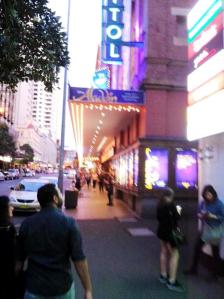
A blurred snapshot of the theatre as we hurried up the street.
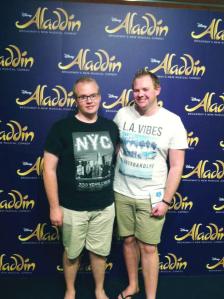
However, one night last week I began to wonder whether there is a class divide between cities. Last Thursday night, my partner and I drove to Capitol Theatre in Sydney to see Aladdin The Musical. In order to save money, the two of us packed our tacos, salad and pre-cooked mince in Tupperware containers, which we ate in the car before heading to the theatre. As Jay and I waited with the crowd in the foyer to get a photo in front of the purple Aladdin backdrop, I couldn’t help but stare at the men dressed in suits from YD, and their girlfriends wearing Dulce & Gabbana dresses and heals. Eventually, Jay and I got in front of the backdrop; wearing our Zoo York t-shirts and Jay Jays shorts.
At intermission, as I lined up at the bar, the men in designer suits were purchasing fifty dollar bottles of sparkling wine with two glasses, while I bought a can of Pepsi and packet of Maltesers for Jay and me to share.
The show was brilliant, and at the end, Jay and I headed to the fourth floor underground in the car park next door to collect our car before making the two hour car ride home. I watched as the crowds parted ways; many making their ways to the apartment buildings and townhouses near the theatre, others went for ice cream.
Perhaps I am over-thinking this, but I have to wonder why the city/country divide seems so obvious. I can’t help but wonder how often we would see a guy from Cessnock take his girlfriend to a restaurant in town, wearing designer clothes, eating caviar and only drinking the best of the best. Likewise, how often would you see two men, born and raised in the heart of Sydney, attending the theatre in shorts and a t-shirt?
Today’s topic was Freedom of the Press, Speech and Information. It sparked a decent level of discussion from the class. Today saw Nadia and I presenting. Nadia presented on how the laws surrounding journalism in Australia can be quite restricting, while I did somewhat of a rebuttal, and discussed how the laws in America make it easy for freedom of speech to be damaging to innocent people in the right circumstances.
Nadia and I both covered how the use of the Universal Declaration of Human Rights in the Australian Press Council (2018) is the main indicator of free speech in Australia. I also went on to discuss the other restrictions for journalism in place in Australia, which included defamation, privacy and contempt (Lamble, 2011).
Jonbenet` Ramsey. Murdered on 26/12/1996. Courtesy of Radar Online.
During my presentation, I attempted to demonstrate how the Jonbenet` Ramsey murder case in America is a very poor commentary on their laws surrounding journalism. Because of the first amendment and promise of free speech, laws surrounding defamation, privacy and contempt are more lenient to avoid infringing on freedom of speech (Legal Information Institute, 2018). I was adamant that the belief by the media and public at large that John and Patsy Ramsey were guilty, and the constant vilification of their character through the media would never happen in Australia. I believed that the laws in place in Australia held journalists accountable for their actions in order to avoid something like this happening.
Azaria Chamberlain and her mother Lindy, 1980. Image Source: news.com.au
However, my entire argument was thrown into doubt when someone mentioned the case of Azaria Chamberlain: the newborn who was taken by a dingo when she was with her family on holiday at Uluru. According to Brown (2012) Azaria’s mother Lindy was found guilty of the murders, and spent over three years in prison before the case was reopened. After a subsequent investigation, there was great criticism aimed at the police, and the media for how much the case was sensationalised, bringing bias to those involved (Brown, 2012).
After looking through this case, I was shocked that it had slipped my mind. Furthermore, I had to wonder: is it possible to stop this from happening?
What laws could you possibly put in place to stop the vilification of innocent people who are awaiting an outcome from a court of law?
Regardless of whether they have been found guilty or not, the public at large will still believe what the media has told them, and in these two cases, information was manipulated, exaggerated and often completely false.
At the end of the day, there is a dark side to every profession we choose to go in. Sadly, the only thing we can do as individuals is continue to maintain a high level of ethics in our work.
This week saw us discussing alternate facts, propaganda and fake news. For me, this was a real eye opener, because these things have been happening since journalism first came about, and is still very much in existence today.
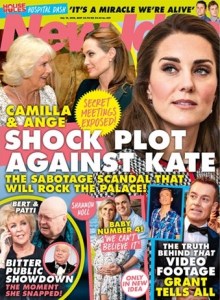
A typical cover of New Idea magazine.
Eren and Maddison both presented historical case studies; one dating back to 1915. Maddison discussed the frustration many readers and celebrities have over gossip magazines like New Idea, Woman’s Day publishing fake news. One particular recent article speculated over Jennifer Aniston possibly being pregnant (Black, 2018).
The class agreed that this kind of fake news nowadays is usually most damaging for the journalist and the publication for whom they are working, because readers are beginning to realise where to go to get reliable facts, rather than gossip. This is backed up by the 12% drop in magazine sales in the US just this year (Golembo, 2018).
However, there was one particular case study presented by Eren which concerned me. According to Kang & Goldman (2016) on a Sunday in December 2016, Edgar M. Welch of North Carolina drove six hours to a pizzeria called Comet Ping Pong in California after reading that its basement was concealing victims from a child abuse ring led by Hillary Clinton. Upon arrival, Welch open fire with a rifle. Eventually, Welch was arrested peacefully, after finding no evidence of concealed children. Upon investigation, it was discovered that the information Welch had been reading on social media was fake (Kang and Goldman, 2016).
This was an extreme case of what sort of repercussions fake news can have on society. Thankfully, nobody was physically hurt. However, the reputations, in this case, of Hillary Clinton and the owners of Comet Ping Pong may never recover (White, 2018). Check out the news bulletin from abc news below.
Like last week, this week’s topic has reiterated the necessity of maintaining the highest ethical standards in journalism. Just one unethical move, like the cases mentioned above can destroy not only the reputation of the journalist and their publication, but also that of the people they are reporting on.
Today’s class saw us looking at the result of the Panama Papers investigation. I had vaguely heard about this investigation, but was oblivious to the extent of it. In 2015, 2.6 terabytes of bank statements, contracts, legal documents and other miscellaneous paperwork was leaked from a Panamanian law firm and corporate service provider Mossack Fonseca & Co (Main and Worthington, 2018).
This investigation was so difficult to get my head around, purely due to the scale of it. Evidently, the operation, using the help of skewed banking privacy laws in various nations, many companies and individuals worldwide were able to launder money for many illegal purposes including drug trafficking and tax evasion (Pegg, 2016). As Will described in his presentation, evidently names like Nicole Kidman, Michael Hutchence, and even Malcolm Turnbull were dropped in the investigation, although Malcolm Turnbull was cleared of any wrong-doing. The video below explains the Panama Papers in a simple and easy to understand way.
Today’s topic got me thinking about investigative journalism and the idea of whistle blowing. The amount of personal satisfaction for the individual who brought this operation to a halt would be enormous. However, in my research one particular new legislation passed by Turnbull known as The National Security Legislation Amendment (Espionage and Foreign Interference) Bill 2017 was passed. Fundamentally, its intent was to stop official government information being leaked and foreign interference taking place as a result. However, this is a step backwards for whistle blowers and investigative journalists, who under the new legislation could face up to 15 years imprisonment (Gregoire and Nedium, 2018). Check out the document here! http://parlinfo.aph.gov.au/parlInfo/download/legislation/bills/r6022_first-reps/toc_pdf/17295b01.pdf;fileType=application%2Fpdf
I have always questioned the idea of investigative journalism. After looking at the Panama Papers case, the idea of whistle blowing is still a tough idea for me. Part of the reason is the stereotypes that surround investigative journalism. These include the idea that journalists operate with the intent of finding a juicy story and printing it, regardless whether it is true or not. Carson in Tanner & Richardson (2013) explains how journalism is not an emotional process. It is an intellectual process comprised of sifting through information from a number of sources and deciphering it to come to the most important thing: the truth (Carson in Tanner & Richardson, 2013).
Image Credit: Colleen Murrell
While I agree with this idea, the fact remains that investigative journalism holds significant risks. Murrell (2018) describes how a bomb in Kabul killed nine local journalists this year, emphasising that keeping safe in conflict zones is essential.
To me, this is quite a frightening prospect, because in order to travel to these places in search of a story would essentially mean being married to your job.
While I don’t feel that I love journalism enough to risk losing my family and friends, I think this is one of those cases where I don’t know how I will react until the opportunity arises.
Tanner, S. and Richardson, N. (2013). Journalism Research and Investigation in a Digital World. South Melbourne, Vic.: Oxford University Press.
29/08/2018
This week’s class saw three presentations about Public Interest Journalism. This was most interesting because it showed an interesting variation of opinion.
MEAA Journalist Code of Ethics.
Andie’s presentation identified the governing bodies and guidelines journalists must adhere to. These include the MEAA, the Australian Press Council, and ACMA. According to the MEAA (2018), the main qualities to which journalists should commit are honesty, fairness, independence, and respect for the rights of others.
The idea of Public Interest Journalism is straightforward. It is information that the public has a right to know as it could affect them.
Original footage taken by Channel 7.
However, some differences of opinion emerged in a case study presented by Chelsea. In 2010, Channel 7 exposed NSW Transport Minister David Campbell leaving a gay sex club in Sydney. Video footage was aired following Campbell as he left the club and drove away. Channel 7 defended its decision to run the story as the car was funded by the tax payer.
Many were torn on what to feel by this. Legally, Channel 7 had not broken any privacy laws; he was filmed in a public place. However, most could agree that journalism ethics were breached. One particular clause in the MEAA (2018) Code of Ethics was, “Do not place unnecessary emphasis on personal characteristics, including race, ethnicity, nationality, gender, age, sexual orientation, family relationships, religious belief, or physical or intellectual disability.”
In this case, Channel 7 focussed way too much on the fact that Campbell was leaving a gay club. It could be argued that had it been a different kind of club, the sensation would not be as great, and Channel 7 might not have even reported on it. In the aftermath, Campbell resigned. Although the backlash and criticism toward Channel 7 was enormous, the damage was done. Below is a clip of a statement by Campbell following the ordeal.
It was barely reported in the aftermath that Campbell had not in fact, broken any rules by visiting the gay sex club. In short, Channel 7 has ruined a man’s reputation and career.
This case is a classic example of what not to do as a journalist. However, there are two sides to every story. Cillizza (2015) emphasises the intense pressure on journalists these days. With jobs in print journalism declining, and less people paying for quality journalism, the people lucky enough to have a job for big news outlets are under heavy time constraints. After all, we are all human, and sometimes we make mistakes. Click here to see the story.
At the end of the day in whatever story I choose to do for whichever publication, all I can do is my best and use my intuition and the skills I have learnt to the best of my ability so as to produce positive results with what I produce.
Today was the first tutorial for Journalism (CMNS3420).
I am somewhat apprehensive about this course because of how long it has been since I performed the journalistic tasks like in Intro to Journalism two years ago. The thought of approaching people in search of interview subjects, and doing them justice with what I produce while remembering to always report the truth without breaking any laws, is still quite daunting to me. My biggest hope for this course is that it will get me over that hurdle.
Image Credit: Mandy Mayfield – Washington Examiner.
This week, Felicity suggested we watch a Showtime documentary called The Fourth Estate. Directed by Liz Garbus, the viewer is shown the coverage of the White House by The New York Times during the first 100 days of Donald Trump’s presidency of the United States. Using running footage of journalists at The New York Times, interviews and press conference footage of Trump, the documentary serves as a rebuttal for one of the first things Trump said as president about the media, that they were “…the enemy of the people”.
This documentary was not only fascinating to see, but also a real eye opener into the way journalists are seen by much of the public, and what their daily lives are like. One particular scene saw a woman in the office talking to her children on Skype, promising that she would be home soon, but knowing that she probably wouldn’t be. Check out the trailer below!
I began to wonder if this is what my life could be like, and whether the fact publications are slowly dying because people do not wish to pay for news anymore means that I am getting into the wrong profession.
What I keep holding onto is the hope that my skills and what I love doing will combine to see me in a career doing something I truly love and can be appreciated for. At this stage however, only time will tell.
15th August, 2018.
During class today, Felicity conducted a mock seminar titled ‘The Literary Conference at University House, UON’. The idea was that the class were journalists writing a news story on the conference in time for their deadline.
After writing this story, I feel somewhat deflated and disappointed. I feel that in Feature Writing and Intro to Journalism I learnt the skills and techniques to produce a quality news story. However, after having not written a news story in over a year, I feel that I have neglected what I learnt early on and have become a little rusty.
I know that I can improve with practise. I think what I have to remember is to focus on the news values, and keeping my pars clear and to the point. Check out what I produced from the seminar below.
Biggins Talks House of Hancock at University House.
House of Hancock is once again in the limelight. Felicity Biggins, renowned journalist and academic at the University of Newcastle this morning gave a seminar on Channel Nine’s failed two-part mini-series titled ‘The Literary Conference at University House, UON. Earlier this year, after a prolonged legal battle, the defamation suit against Channel Nine by Gina Rinehart was settled out of court. Channel Nine issued an apology. According to Biggins, ‘…they said they’ll never broadcast it again. I don’t think you can even access a trailer. If you had a DVD copy it would be worth a lot of money.’
Felicity Biggins speaking at UON.
Biggins hopes to bring more awareness to journalists and media producers from this.
Biggins spoke of the creative freedom writers and media producers have when it comes to the projects they undertake. She described the idea of historical fiction, and how easily one can embellish characters, events and timelines.
However, Biggins expressed her concern over non-fiction, and used House of Hancock as a prime example of what not to do. In her seminar, Biggins quotes Watroba,
“It is based on scenes which either did not occur…unfair portrayals.”
Advert by Channel 9. Image Credit: Australian Times.
House of Hancock first aired in 2015. The mini-series depicts the life of Australian mining magnate and chairman of Hancock Prospecting, Gina Rhinehart.
According to writer Katherine Thompson, the mini-series was difficult, “…let’s face it, I had to make an awful lot up, because she hasn’t written an autobiography.”
Biggins maintains that this was a mistake. While there is a need for public interest in stories like these, there are guidelines which must be followed.
According to Biggins, “I found the comments from the producers afterwards quite arrogant”, and she felt that after the prolonged legal proceedings they had not learned from their mistakes.
Biggins finished by asking whether this situation is really serious, or, “Is it just a storm in a teacup?”
She maintains that guidelines should be followed by journalists and media producers to avoid this in the future.
We’ve all seen it before. Some of us are lucky enough to have only seen it on tv, but it is remarkably common. Most of us have just a select few special lifelong friends who we would trust with our life. Some will have a larger group of friends and acquaintances who they interact with from time to time but aren’t that close with.
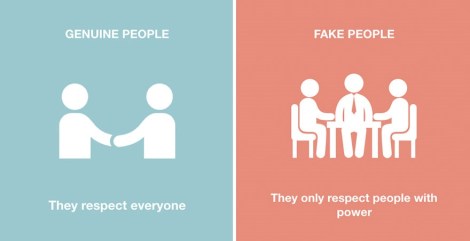
But, like every scenario in life there is that dark side to look out for. Some people are not genuine friends. Some people choose to play the part as a means to an end. In some cases in the school yard kids will suck up to the queen bee in order to move up the social ladder. In the prison setting you will see the frightened weak inmates do anything to gain protection; the old ‘If you can’t beat them, join them’ routine. Even in the workplace we see employees sucking up to the right people in hope of currying favour for that promotion.
These are extreme cases, but fake people are everywhere, and they will strike up “friendships”, and play it out until they have what they want, and then they walk away without a second thought.
But how do you tell whether you have met a sincere friend, or an actor performing a snow job?
They arrive suddenly into your life after having known you for ages. This tends to happen after a sudden change. You either get a new job, win Lotto or come to possess something appealing to others. They act like they’re your best friend, even when you’ve made no effort to be their friend. This is not to say that new friends cannot be made. A genuine friendship would generally occur mutually after perhaps running into each other, striking up a conversation and going from there, or realising you have a common interest, bonding over it and growing closer from there.
Their general behaviour is over the top. This could be something as simple as spending a ridiculous amount of money on a birthday or Christmas present for you. A sincere friend will generally measure a gift on its sentimental value, not on its dollar value.
They are nowhere to be found when you’re having a crisis. Say, you have a death in the family. Naturally, your closest friends and family flock to your house with flowers and their condolences. The fake friend however will maintain a distance, because they don’t actually have any emotional connection with you.
They feel threatened by your other friends. This is purely because they do not want to share what they’re after from you with anyone else. Plus, they probably know that your real friends can tell that they’re just pulling a snow job.
As soon as you outlive your value, you never hear from them again. We like to think that most people have the common sense not to fall for this kind of person, but it does happen. After they have received that “loan” from your Lotto winnings, that promotion, or they’ve finally realised you’re not going to give them what they’re after, the two of you drift apart, or they find some excuse for the two of you not to be friends anymore.
A quote I found which felt very relevant.
It is hard to describe what a true friend actually is, but when we have one we know in a heartbeat that what we have is for real. Remember to use your common sense, and if ever in doubt, ask yourself what you could offer the person in question and why they might be trying to take you for a ride.
My sincerest, friendliest and happiest wishes to all.
In 2008, ABBA fans of all ages were delighted by the release of Mamma Mia! The Movie starring Meryl Streep, Amanda Seyfried, Dominic Cooper and Pierce Brosnan. Now, ten years later they are back with a second instalment: Mamma Mia! Here We Go Again.
The sequel, directed by Ol Parker takes us five years after the original, where Sophie (Seyfried) is preparing for the grand reopening of her late mother Donna’s (Streep) hotel. She is still grieving her mother’s passing, and there is much to do in such little time before the big day, and her marriage with Sky hits the rocks after he receives a permanent job offer in New York. Meanwhile, two out of three of Sophie’s potential fathers are unable to make it to the island for the reopening.
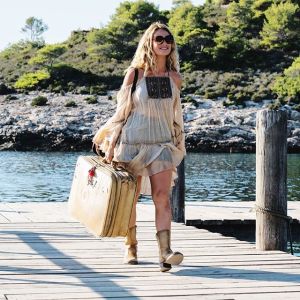
Lily James as young Donna.
We are taken back to Donna’s care-free days after her graduation, when she meets the young Harry in Paris. Played by Lily James, we see young Donna in a whirlwind romance with young Harry (and him charming her into taking his virginity). Soon, Donna and Harry part ways as she travels to Greece. When she misses her ferry to Kalokairi, she is offered a ride by Bill. After a memorable trip to the island, which included helping a stranded fisherman stop the love of his life marry another man.
When Donna arrives on the island and begins squatting in an old farmhouse, she meets Sam, who helps her rescue a horse also living there during a storm. The two have a whirlwind romance and Donna can actually see herself with young Sam, until she finds a photograph of him with his fiancé and throws him out.
When young Donna’s best friends Rosie and Tanya come to visit her, Donna channels her anger and sadness into song as she sings ‘Mamma Mia’ at the local bar. It is here that ‘Donna and the Dynamos’ is formed.
To be honest, I was surprised to see Lily James play the part of young Donna, after her fantastic performance in Cinderella (2015). After playing such an angel, I didn’t know how she would go as the free-spirited, somewhat ditzy and clumsy Donna, but she did it!
In the present, things take a turn for the worst as a storm destroys the setup for the hotel’s reopening, and grounds all ferries and transport from the mainland.
With the return of Bill however, we see Harry, Sky, and a whole heap of randoms from the mainland arrive at the island in true Mamma Mia style!
I do consider myself an ABBA fan, but I am sad to say, I have not heard every album from front to back, hence much of the set list in Here We Go Again was completely new to me!
While we were delighted with the usual favourites like ‘Mamma Mia’ and ‘Dancing Queen’, other less known songs made appearances: ‘When I Kissed the Teacher’, ‘One of Us’, ‘Knowing Me, Knowing You’, and ‘Andante, Andante’, to name a few.
However, nothing prepared me for the special appearance of Cher as Sophie’s grandmother, followed by her red hot duet performance of ‘Fernando’ with Andy Garcia. Check out the sneak peek trailer below!
What never ceases to amaze me is how easily life’s problems are solved in musicals. When things seem to be at their most hopeless, a song is performed, and the problem is solved. In the first Mamma Mia film, we saw the dilemma of who Sophie’s biological father could be. Instead of having a blood test, Sophie decides that all three men would play the part of her father. As for the sequel when Sky is offered a job in New York, he heads to Greece, and after a song or two, he decides that he won’t take the job! To add to this, Sophie knows she is pregnant after throwing up once!
I felt the same way after watching High School Musical. After all the fuss about auditions and the uproar the school would be in, we never got to see so much as a sneak peek of the musical.
Anywho, Mamma Mia Here We Go Again definitely did not disappoint, and I easily give it 4.5 stars with my blessing. A feel-good movie like this helps put things in perspective, and puts you into a good mood, which is what I love most about it.
Check it out in cinemas now! The soundtrack is also available on iTunes and in stores.
As I said in the video above, there’s been something playing on my mind for the last few weeks.
Life is precious, but it can also be short, and can be taken away in a split second. Recently, two children were shot dead in Sydney. A young girl survived an abduction and rape in Newcastle several weeks back.
In 2003, 13-year-old Daniel Morcombe went missing. His remains weren’t found until 2011. More than 38,000 people are reported missing in Australia each year. There are over 1600 people who have been missing long term.
I think the only thing worse than knowing that your loved one has been abducted, tortured and raped before being murdered, would be not knowing.
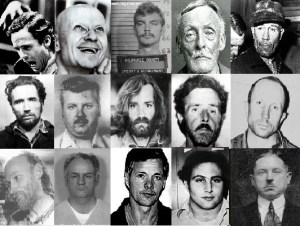
Just some serial killers worldwide.
There is an entire television network dedicated to true crime, and a long list of killers, psychopaths and rapists who were detected and arrested.
But what about the ones who weren’t? How many killers, psychopaths and rapists are still operating and walking among us?
Those people on tv are the ones who didn’t cover their tracks well enough. What about the ones who haven’t been detected yet?
Furthermore, how do we protect ourselves and our loved ones without imprisoning ourselves?
It’s too bad rapists and murderers don’t have horns on their heads. So, how do you pick them out of the crowd? In most cases, you can’t. But here are a few helpful hints to keeping safe, regardless of your age, gender or location.
Listen to your gut instinct. If the voice inside you is telling you that something isn’t right, listen to it and leave. It is better to offend a stranger than to fall victim to a predator.
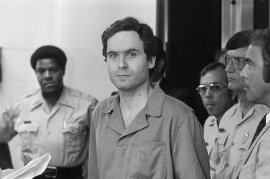
Ted Bundy
Did you know that Ted Bundy, one of the most infamous serial killers in the US lured his victims by wearing a fake plaster cast and asking young women to help him to his car? When they arrived, he would hit them over the head with a tyre iron.
Use well known, well lit and populated transportation routes. It is asking for trouble walking in a dark back street alone at night. If you have to walk somewhere, regardless what time of day, stick to main roads and well-lit areas where people will see you if something happens to you.
Predators are less likely to strike if there is a chance they will be seen. Predators like Fred and Rose West found many of their victims at bus stops in country areas late at night, offering young women lifts.
Remember, predators can be women, too! Predators like not just Rose West, but also Moors Murderer Myra Hindley both admitted that potential victims were more likely to accept a lift with a woman in the car.
Make it known that you have strong family connections. Predators will search out potential victims in even the most mundane of places like the pub, the dog park, even at the shops.
Jeffrey Dahmer.
If a predator chats you up, chances are they are checking you out to see if you would be missed if you were to disappear. Jeffrey Dahmer, the cannibal from Milwaukee would chat up young men in bars, and if they were runaways with little or no family connection, he would invite them back to his flat.
Do not hitch hike. Ensure you investigate public transport before you hit the road.
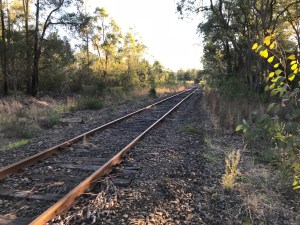
Ivan Milat
In Australia, the distance between destinations is often great. Between 1989 and 1992, Ivan Milat murdered seven young backpackers after offering them lifts on the Hume Highway. These days, the risks associated with hitch hiking are too great.
Use your common sense. Many predators look for victims of opportunity. One particular trick is to stick a piece of paper to the back of your car. The idea is that when you are leaving, generally late at night, you will get to your car, see the paper, and get out to move it. This is when the predator strikes, when your wallet and valuables are all in the car, and the keys in the ignition. If you get into your car and see a piece of paper stuck to your back window, do not get out of the car to remove it. Lock your doors and drive away.
Ensure the whole family has access to a mobile phone. This may seem excessive, but if you have children who catch the bus and or walk home on their own, a $20 phone loaded with $10 credit will relieve your worries and give them a way to contact you in case of an emergency.
Be prepared. When you’re going out, say, for a night on the town, plan ahead. Assign a designated driver, or organise an Uber for when it is time to go home. Don’t get yourself into situations where you are left alone with strangers or left stranded with no way home.
Remember, in case of an emergency, call 000.
I hope you liked this week’s Word From Brett. I’ll see you all really soon!
June 20 saw the ban on free single-use plastic bags in Woolworths supermarkets. From July 1, all other retailers including Coles will implement this same ban.
Discarded plastic in the ocean.
For those of us who care about the human impact on our environment, this move is long overdue. However, in the last week the backlash from the media has been impossible to avoid as the public, and media organisations accuse companies like Woolworths and Coles of squeezing a few dollars and playing the environment card to get away with it.
But let’s think about this for a minute. A 2016 study found that supermarkets like Woolworths and Coles give out around 4 billion single use plastic bags a year. Of these, at least 1% find their way back to the environment. This means that the oceans and landfills are wearing the consequences of our supermarket habits. To make matters worse, these bags take hundreds of years to start breaking down, if at all.
So, what is the solution?
Bag options available at Woolworths supermarkets.
At present, Woolworths and Coles have alternatives like a more durable plastic bag for 15 cents each, a foldable enviro bag, or the conventional green enviro bag, both for 99 cents each, and of course the freezer bag at $2.49. Much of the outrage has come from the fact that plastic bags are still on offer, but at a price.
What we need to do is ask ourselves a few questions. The thought of buying more bags at every shop gets costly. Does the thought of having to pay for your bags when you buy just a few things make you think twice about whether you really need one? Does this compel you to bring your own back with you?
Another argument against the ban is the other purposes the bags are used for: rubbish. With no free bags, people will have to buy their own garbage bags. Again, with the thought of having to pay for your bags, do you think you will be more mindful of how many you are using, and how much rubbish you put in each one?
I feel the answer to most if not all of the questions above is yes, hence I firmly believe that the production and use of plastic will decrease significantly.
Others have expressed their distaste at the fact that such retailers still sell pre-packaged food wrapped in, you guessed it: plastic. Free bags are also still on offer in the produce department.
What we all need to remember is that Rome wasn’t built in a day. This is one very big step in the right direction. Woolworths and Coles have both stated that they are looking at alternatives for plastic produce bags, but it is a work in progress, and these things take time.
After hearing so much about the ban on plastic bags for the past few months, I am baffled that the way in which we transport our purchases from the shop to our homes has provoked such an angry response. Think about it. Single-use plastic bags have been banned in the ACT, South Australia and Tasmania for several years now. Western Australia, New South Wales, Victoria and Queensland are merely following suit. So, why is this such a drama when we are reducing our footprints on the environment for our children and grandchildren?
Here are a few ways to help you with the transition:
Put some enviro bags in the car, so that you’re never caught short when you make an impromptu trip to the supermarket.
Buy some foldable enviro bags to keep at the bottom of your handbag or back pack.
Re-use the single-use plastic bags you still have at home. This will reduce the distribution of the new re-usable bags and will save you money.
Take a basket shopping with you. Some people have those nice old wicker baskets, but you can take a laundry basket if you so desire.
Simply load your purchases back into your trolley loose, and pack them into your bags in the car, or don’t even bag them at all!
With these helpful hints, the transition should be a little easier. One major concern for retail workers is the backlash the cashiers would receive from customers. Already, the SDA has released a campaign called ‘Don’t Bag Retail Staff’. Check out the ad below.
This is the part that concerns me most: the fact that people are stupid enough not to realise that the ban on plastic bags has nothing to do with the fifteen-year-old standing behind the counter. Thankfully I personally have not witnessed much more than the odd eye roll from the odd customer, but I am just one grain of sand on a huge beach. To sum up, please try to think of the removal of single-use plastic ban as an important step to preserve the beautiful lands and oceans around us. It is a work in progress, and we are far from our goal, but it is a start. My happiest, cleanest and waste-free thoughts to you all.
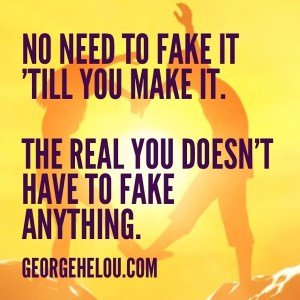
We’ve all seen it before. That old line used to tell people that if they believe in themselves, they can do anything they want to do or be anything they want to be.
This really jumped out at me in my travels. It says in one what I’m trying to say in this post. Credit: George Helou
I don’t want to take away from this sentiment. After all, positivity is contagious, and many of us get by each day with fantasies at the forefront of our minds. For example, I would like to think that I have the potential to write a hit series. Chances are my writing isn’t that great. But it’s what I love doing, so I keep doing it. I fake being a hit novelist, so that in my own mind, I am happy.
Have you ever faked something? Chances are, unless you live under a rock, you will have faked something at some point in your life. There are many different types of fakers out there.
The actor. This is the most common and acceptable form of faking. For some, this is a high paid job as they pretend to be somebody else in front of lots of cameras in a studio. For others, this means going to the office and politely helping angry clients. When they go home, they become a parent, child, a husband or a wife; another part they are playing.
The change-about actor. The aspects of this faker are really just physical. They have different costumes for every occasion, mood and season. These people tend to wear heavy make-up and shudder at the idea of being caught out not looking attractive. While this actor comes across very vain, they suffer from low self-confidence and are merely making up for it in other ways.
The try-hard. This faker fabricates aspects of their personality and even acts as a chameleon to get ahead in some way. In the school setting, this might be a girl desperate to be accepted into the popular clique. In the workplace setting, this might be an employee desperate to get that promotion from their boss.
The attention seeker. This faker can go to one extreme or the other. They could be a Negative Nelly, or an eccentric who says and does shocking things for people to stay interested in them.
The hypochondriac. This person appears to constantly be ill, or injured, and play it for all it is worth to gain sympathy.
The one with no self-esteem. This faker also acts like a chameleon, and tends to be an outright liar, as they fake their way through social situations, pretending to like people they would happily never see again, just to climb up the social ladder and cover their insecurities about themselves.
Say, for instance, you go out on a date with a really nice guy. You buy a fancy outfit that maxes out your credit card. This guy is a successful businessman with a six digit salary, who you desperately want to impress. So you turn up in a limousine, order the most expensive wine and steak, and talk about how you own your own business and live large. Eventually, he finds out that you are a retail assistant still living at home. Was it really worth it?
Chances are the people who do this are not bad people, but they do not love or respect themselves enough to take a moment to be honest with themselves and like themselves for who they really are. How can one tackle this issue though?
Here are just a few tips that can help you to open up to yourself and be selfless and truthful.
Ask yourself: What are your values? What are the most important things in your life? Is it success? Money? Good health and love for your family? What are your worst fears? Dying alone? Losing your job? Having no friends? Write them down. Think about how much they have changed since you were young.
Ask yourself: What do you really stand to gain by not being yourself? If the people you are trying to impress don’t like you for who you really are, logic would tell you that you deserve better, be it a lover, friends, or a potential employer. Make yourself a mental list of everything you like about yourself, and try to show off these high points of yourself, rather than trying to be someone else
Be genuine! In general, most adults are smart enough to know when the person in front of them is for real, or is just trying to fool you. Some of us are better actors than others, but even the best actor cannot sustain being a fake a person forever. Sooner or later, they will make a mistake, and the facade will unravel.
Remember, it is your imperfections that make you a real person! By being real, people can relate better to you, because they know that you’re human. Genuine human beings make mistakes, don’t look perfect, sometimes say the wrong thing, and sometimes trip over in front of everyone.
By following these four tips and being completely honest with yourself, I guarantee that you will find the right people for you. These things do take time, but by being genuine, you will attract those who will love you for you, not the façade you’re creating. Remember, people can’t see the amazing person you are if you’re busy trying to be someone else.
 At intermission, as I lined up at the bar, the men in designer suits were purchasing fifty dollar bottles of sparkling wine with two glasses, while I bought a can of Pepsi and packet of Maltesers for Jay and me to share.










 Use well known, well lit and populated transportation routes. It is asking for trouble walking in a dark back street alone at night. If you have to walk somewhere, regardless what time of day, stick to main roads and well-lit areas where people will see you if something happens to you.

 The idea is that when you are leaving, generally late at night, you will get to your car, see the paper, and get out to move it. This is when the predator strikes, when your wallet and valuables are all in the car, and the keys in the ignition. If you get into your car and see a piece of paper stuck to your back window, do not get out of the car to remove it. Lock your doors and drive away.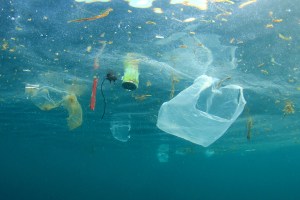

 Say, for instance, you go out on a date with a really nice guy. You buy a fancy outfit that maxes out your credit card. This guy is a successful businessman with a six digit salary, who you desperately want to impress. So you turn up in a limousine, order the most expensive wine and steak, and talk about how you own your own business and live large. Eventually, he finds out that you are a retail assistant still living at home. Was it really worth it?
