Well, we’ve come to the tail end of 2018! It’s been a very interesting year, that’s for sure. First and foremost, I want to say a huge thank you to everyone out there who have followed and read A Word From Brett.
When I first started writing A Word From Brett I didn’t have much clue what I was doing, or even what I was going to write about! Writing is such a therapeutic way to get things off your chest and make sense of the world around you, as I have come to find.
What I would like to know is, what was your favourite thing on A Word From Brett? Was it A Tip From Brett, with all the random life lessons? Or would you like to see more film and music reviews?
Make sure you let me know in the comments section below!
You know what, it is amazing what a year of experiences can bring us, both negative and positive. For me personally, I have had my fair share of both in 2018.
I think for me, negativity is very draining and sad because most of it comes from the people we choose to surround ourselves with. It is safe to say that most of us want something positive to come out of our time on Earth, and life should be fun. Even sitting on the back patio having a beer with your friends should be fun.
Sadly, this year I realised that I have invested too much of my time with the wrong people, and as a result I wore the consequences. In life we do need to have someone to share our love, goals, dreams, aspirations and stupidity with. I don’t just mean our lovers but our friends too. More importantly, we need to immerse ourselves with people who love and respect us the way we love and respect them. It is important to know that when all hell hits the fan, the people we cherish most are there for us, but we need to ensure that we are also there for the ones we love, too.
At the risk of overcomplicating things and contradicting everything I just said, if this year has taught me anything it is that life is too short. The simple things are what matter most. By this I mean, an appearance is worth a thousand words. What I appreciate from my friends more than anything is knowing they’ll be there to have a coffee with me, laugh with me over a wine, and cry with me when I’m upset rather than how much they spend on me at Christmas. It is the simple things which matter most.
One of the saddest realisations I have had this year is the nature of humans and the impact they have had on the world. So much devastation has come to the world as a result of humans, yet there is something so organic, pure and innocent about our animal friends which I find incredible. They live by their instincts and pure minds; they’re not corrupted by power or money or fame. Even religion; a concept designed to focus on love, karma and doing the right thing by others has brought with it more wars, murder and hatred than anything else in the world.
To sum up this long thought, it is time for me to get back to basics. Positive vibes, positive actions and positive people are what bring happiness. However, there is only one person who can do this: me. By putting it out there, I know I will get it in return, which I’m determined to do.
Onward to the future. 2019 is already shaping up to be full of excitement and new possibilities. Not only is A Word From Brett going to be expanding and seeing new horizons, I am also taking a semester off uni for my wedding in April, and to spend time editing my second novel before I undergo the process of self-publishing.
June will also see A Word From Brett go international, as we take a trip to the UK and Europe!
So, I guess now there’s nothing left to do but count down the end of 2018, and start the new year with a bang! Be sure to keep following A Word From Brett on Facebook, Instagram and Twitter to read the latest!
Well, it’s that time of year again. The silly season, the season to be jolly, Christ’s birthday, a time for giving and a time for receiving. For many, it is also the time when bank accounts are drained because they are buying pointless gifts for relatives who don’t appreciate it. It is also a time when going grocery shopping becomes a war in the car park, and a trample fest if you’re lucky enough to make it inside.
It is true. The real meaning of Christmas has been lost to the retailers, and the nutters who only care about how much money can be spent on them. For the hard workers out there, this is meant to be that holiday time at the end of the year when they can take a break, but even this concept has become a sham, as nearly every “public holiday” (minus Christmas Day, Good Friday and Easter Sunday), sees most working anyway, just at a higher rate.
As a result, so many people now dread Christmas. It is too commercial, it is impossible to find any peace in a public setting, and it’s meaning is lost. But how can you enjoy Christmas as it is meant to be enjoyed?
For the Christians, that will generally mean spending more time at church as they praise Jesus Christ.
Some people who do not identify as Christians feel like a hypocrite by celebrating the holiday, and often feel suffocated by it from October through to the end of December, but they really shouldn’t feel guilty.
For people like me who are not religious, I feel it fair to say that the point of Christmas is the time to spend with family and friends doing what is most important. But how can one possibly do this without having to become a product of the holiday and sending themselves broke?
Treat Christmas Day like any other gathering. This may sound strange, with how often we’ve been told to treat every day like Christmas. By this I mean, organise for everyone to bring a dish so that the cost is reasonable for everyone. Don’t just make one person host and be lumped with the bill, because one day that could be you. Also, put forward what you would like to eat on the day! There is no point having to pay for ham and prawns if you’re not even going to eat them. There is something to be said for tradition: it tends to be overrated! If you want fairy bread, party pies, sausage rolls or pizza, get them! There is no law against being different on Christmas Day.
Set a budget on presents and limit how much you have to buy extended family members. One foolproof method of doing this is setting a $100 spending limit with your significant other, and for everyone else: Secret Santa. Names are drawn out of a hat and everyone buys a $30 gift for the person they have chosen.
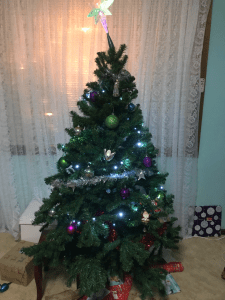
Get in the spirit and decorate. Don’t go overboard though. Even on a modest budget, it is never hard to find a good special on a small Christmas tree, some tinsel and lights. When Christmas is over, you can pack the decorations up and use them next year!
When it comes to buying food for Christmas Day, plan ahead! Book your food if possible, or get to the supermarket nice and early on Christmas Eve to get your supplies.
Plan your shopping trips carefully!The second half of December is an absolute rat race when it comes to performing simple tasks like going to the supermarket. Thursday mornings are the time when pensioners do their shopping, and there is usually a lull between 1 and 3 before the mothers come shopping with their kids after school. At 6 o’clock you’ll also get that dinner rush. Keep these times in mind and try to pick a quiet time to shop. Sometimes however, there is just no predicting when it will be busy, and we need to be patient during this busy time.
Put your patient pants on. It’s a hectic time! Over Christmas is the time when most businesses take time off. Because of this, it sends a panic through the clientele. Blowing up in anger because you’ve had to wait a little extra time for an appointment does not help anyone, and will only upset you, and the people around you. If possible, set aside extra time for appointments and errands, and should you have to wait, be prepared with a book to read, or some games on your phone to pass the time.
If you’re planning to take a holiday, be careful when and where you go. Chances are, many other people have had the same idea as you. Most coastal areas with motels and caravan parks book out months in advance, and if you’re lucky enough to get in somewhere, you’ll be surrounded by other young families with children.
Be thrifty, not grinchy! Being more aware of the fact that Christmas is just another day of the year and being careful with your money doesn’t mean that you refuse to embrace the holiday, or worse still, put down the people who do embrace it. Do your best to enjoy the occasion, and have a laugh with your family and friends.
Don’t be selfish. Most of us would love to have every member of our family sitting around the table at the same time having lunch. Unfortunately, there are at least two sides to every family, and compromises must be made. Don’t be one of those people who demands Christmas lunch every year, “Because it’s tradition”. It’s all about compromise. Talk about it with the family. One foolproof method is to alternate, so that at least every second year you get your turn.
This is for the non-religious holidayers. Don’t get yourself into the middle of something that isn’t your scene. Discuss the happenings of Christmas Day with your family and ensure everyone is on the same page regarding the theme of the day.
Christmas Day is not everyone’s favourite holiday, but celebrating it does not mean being the Christmas nazi, or the Grinch. There is something to be said for tradition: it is overrated. Put your own spin on the day, and do what you want to do, so that both you and your loved ones enjoy the day!
With these tips you can get through the silly season that little bit easier.
All the best from Brett for Christmas and a Happy New Year!
Dear Diary. Well, that’s another year of uni done and dusted. People still ask me: What are you going to do when you finish uni? My answer is still the same: I have no idea. What I would like to do is be one of those old men who sits in his enormous library filled with shelves of old books, my laptop in front of me as I write fantasy stories endlessly. Expressing myself and my thoughts in a way that is legible and isn’t tongue tied has always been tremendously difficult for me, and writing gives me a way to do it.
This looks something like my fantasy workspace.
Sadly however, economically this fantasy of mine isn’t really feasible. I guess we’ll just have to wait and see. As I’ve finally had the free time to spend at home going through my belongings, I’ve been amazed at just how much stuff I have and how little I use most of it. One thing I’ve learnt is that there are two kinds of “Stuff” people. The first is the kind who doesn’t like clutter, and minimise any material belongings by regularly culling their stuff. These people tend to maybe take a photo or two which is stored on their Google Drive, and keep their memories close to them, rather than physical possessions. The second however, is the one who hoards absolutely everything that once had some kind of value, even stuff they bought at novelty shops, “…because it’s cute.” I’m ashamed to say that I have been known as a hoarder in my time, and it hasn’t been easy at times. While holding onto artefacts has had its novelties at times, these things do have a habit of slowly taking over your life. In the last month I have seriously started going through and culling unnecessary clutter, and the feeling of empowerment is incredible. I think the most serious questions you have to ask yourself is: 1. Does this hold sentimental value? 2. Does this hold any practical value? 3. Does this weigh you down in any way?
Thankfully my house has never been this bad, though it has felt it at times!
In the last few months, I have started culling clutter, which has not been easy. I’m what I would describe as a tactile sentimental, in that I like to hold onto artefacts from times that were important to me. However, there did come a time where it was time to say: enough is enough. Too much clutter began to mentally and physically weigh me down. It was becoming difficult to organise anything. Something we sadly often forget is the fact that we will often hold onto tools, books, movies and never use them when we could donate them to charity where people in need can get some use out of them.
However, I feel that I need to point out the old fashioned myth that people who do not hoard junk are better able to organise their life. Not true. While there are hoarders who are snowed under by all of their belongings, there are also compulsive cullers who throw away everything, even important necessary items, and as a result, run into problems.
I have witnessed people on both sides of this fence, and I feel there definitely needs to be a happy medium. I am definitely a sentimental person and like to have keepsakes of special events. For example, whenever I travel, I like to bring home a snow globe or keyring to add to my collection. I also keep my photo albums up to date. That’s right, I keep my physical photo albums and go to Big W to have my photos developed every few months. These are the things that are important. However, there are other things we tend to hoard that simply weigh us down. I feel like every now and then, it is essential to go through and de-clutter my life, both physically and symbolically.
In 2012, after rationalising and ignoring years of lies, deceit and outright selfishness, I knew it was finally time to walk away from a friendship. This was one of the hardest things I ever had to do. What was even harder was the fact that after ignoring about two phone calls and three messages, I never heard from said friend again, and that was that. Yes, I probably should have spoken to them about it, and yes, ignoring them probably wasn’t the most mature thing I’ve ever done. These are all stories for another day. My point is, eventually, I realised that in order to go forward with my life, I needed to remove the clutter left behind by this friendship. By clutter, I mean I had to go through my photo albums and throw out all the silly selfies we took, anything of the two of us which didn’t have any real meaning. I did however keep a couple of nice shots of us together at our schoolies trip, another trip we took, and at our mutual friend’s wedding. These were photos I just couldn’t get rid of. This might sound like I’m rationalising as most hoarders do, but I disagree. These photos were representations of particular times in my life. These were times when I needed my friend. Eventually, I outgrew them, and I needed to walk away. As I walked away, I took a life lesson from the friendship, and by holding onto a valuable keepsake or two, I’m holding onto the memory of the lesson I learnt. I suppose this is part of the grieving process. I was grieving the loss of my friend, and for those first six months, I thought maybe something would happen and the friendship could be repaired. This is probably what experts call denial. When I finally decided to declutter, I had accepted it and knew it was time to move on.
To sum up this entry, there are many types of clutter. The momentos from my friendship was just one example. As for other clutter like tools or things you’re just holding onto “just in case”, my golden rule is two years. If it hasn’t been used in two years, have a look for a family member or friend who could use the item, or better yet, donate it to a charity bin. By doing this at least it isn’t being wasted.
To sum up, it is necessary to declutter our lives now and again. But just because you might be a tactile sentimental person, doesn’t automatically mean you’re going to end up on the show Hoarders.
Want to know how you rate as a hoarder? Click here to take the quiz and find out! All my love, xoxo Brett
Kevin Rudd’s time as prime minister saw big changes for indigenous Australians. In 2008, the prime minister delivered a heartfelt apology for all the wrongs done to Australia’s first people.
The Closing the Gap annual report. Image Source: closingthegap.pmc.gov.au
That same year, the ‘Closing the Gap’ initiative was introduced to close the socioeconomic gap between indigenous and non-indigenous Australians. This shocked many Australians, because even though the White Australia Policy was long gone, indigenous people could now vote, and Australia was putting their checked past behind them, it wasn’t that simple.
Studies from 2006 revealed that 16% of indigenous adults were unemployed, while 76% of those who were employed worked in the labour force compared to 5% of non-indigenous adults. The same studies also found that the life expectancy for indigenous men was 12 years less than non-indigenous, and 10 years for lower for indigenous women than non-indigenous. Furthermore, in 2006 indigenous Australians made up just 2.5% of Australia’s total population.
The ‘Closing the Gap’ initiative was introduced to widened housing, education and employment opportunities to indigenous Australians, in the hope of halving these statistics over a period of ten years. Check out the clip below, featuring an excerpt from Behind the News on the progress made.
Now, at the end of 2018, each of the issues mentioned above are still major issues, with little or no change to the numbers. Furthermore, hideous stereotypes have emerged; accusing indigenous Australians of abusing the system, never having to work, pay their dues or take any responsibility for their actions.
With the initiatives put into place, I am asking why a positive change is so lacking? Why instead, are indigenous Australians being portrayed as not wanting to work or achieve anything, yet still have everything handed to them on a silver platter? Are non-indigenous people being pushed to the wayside unfairly?
What one needs to remember first is what indigenous Australians have been through. In September 1901, the White Australia Policy was introduced for, “…by reasonable and just means, the deportation or reduction of the number of aliens now in our midst.”
There was no secret about it. Indigenous Australians were to become extinct by their invaders. As our government waited for the eventual extinction of Australia’s first people, there was a clear divide in everyday life. Indigenous people were segregated from white people in pubs, public rest rooms, even public swimming pools.
In 1967, Aboriginal and Torres Strait Islander people were finally granted citizenship and given the right to vote, and in 1973 the White Australia Policy was finally abolished by the Whitlam government. This should have been a new beginning for Australia’s culture, but it was not the case.
In Australia today, there is still a huge culture divide between city and country areas. Take a trip to a city like Melbourne, Sydney, or even Newcastle, and you will find a great level of diversity; people of ethnicities and religions worldwide will all frequent the same street.
Take a trip to a town out in the country, and it is a very different story.
I remember four years ago, when I went to the Country Music Festival in Tamworth for the first time. On the night we arrived, we decided to take a walk up the main street to check things out. Almost immediately, it became obvious that we were the odd ones out. All around us were groups of teenagers hanging around the streets. Each one of them were clearly of Aboriginal decent. As a result, the Police presence grew with every minute we were there. Other passers-by were making obvious efforts to avoid the youths. What shocked me was the fact that the teenagers weren’t really doing anything wrong, yet people’s reaction to them was so strong, it was as if they were all waiting for something horrible to happen. I had to wonder: If the same thing were to occur with a group of Caucasian teenagers, would the same reaction have been provoked?
These days, it is impossible to belong to just one ethnic background, thanks to migration and changes in attitudes. Unfortunately, this also means that, to the naked eye, an indigenous person might not necessarily look like a stereotypical indigenous person.
In the last ten years I couldn’t help but notice a new stigma emerge as a result of ‘Closing the Gap’, not just accusing indigenous people of abusing a program designed to help the less fortunate, but even accusing people of not even being indigenous, based on their skin colour. But, just how significant are the benefits that ‘Closing the Gap’ provides?
The only way to answer this question is to ask someone who has life experience as an indigenous person.
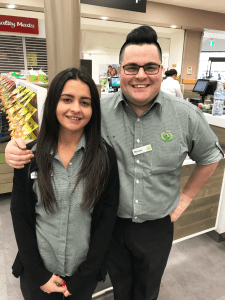
Angel Seiver wears her Woolworths uniform with pride and works hard.
Angel Seiver is a 21-year-old Aboriginal young woman living in the country town of Cessnock with her mother and siblings. For the past two years, Angel has worked as a Service Cashier at her local Woolworths. Earlier this year, her mother Michelle was also fortunate enough to gain employment in the same role.
As we sat in the back office at Cessnock Woolworths, Angel reflected on her first experience with the company, “I went through a company called Diversity. There were a handful of us Aboriginal people, and we did five days of theory work and five days practical, where we were divvied up and sent to different Woolworths stores,” she said thoughtfully. “Then if I was successful I got a position afterwards, so that was amazing.”
A country girl at heart, Angel talked fondly about her upbringing with her mum, who often struggled to get work. “We’ve always moved around a lot,” she said, counting on her fingers as she spoke, “I was born in New Lambton and spent my first few years at Rathmines, then I’ve been between Cessnock, Kurri Kurri, even up near Lismore, then Swansea. The last two years I’ve been in Cessnock is the longest I’ve stayed in the same place.”
When asked about ‘Closing the Gap’ and the terrible stigmas surrounding indigenous Australians, Angel was perplexed, “What really annoys me is that out of my cohort of people to go through Diversity, I am the only one who is still employed. I’m actually one of the only people to go through that program and keep a job long term,” Angel shook her head, “Like, the stereotypes are sad and everything, but there is some truth in them, and some members of my family live up to them!”
It was shocking to hear these words coming from a young Aboriginal woman. It was definitely more than I had bargained for. Angel was adamant however that she knew the key to this problem, “It’s education more than anything. It’s not just indigenous people either – you get this sort of behaviour with everyone, but I think by giving people so many extra benefits, people start to think they shouldn’t have to work for anything, and that’s just crazy!”
It wasn’t long before I was meeting Angel’s boss, Michael Alexandrou: Customer Service Manager at Woolworths, Cessnock. Having worked for the company since 2005 and working as a manager since 2009, Michael holds unique insight to the company and many of its employees.
“Woolworths works with Diversity to give indigenous people work experience, and if we think they’re good for the company, we will hire them and place them on a minimum 15-hour contract. That’s what they’re promised.”
Angel Seiver and her manager: Michael Alexandrou.
I couldn’t help but enquire as to Mr Alexandrou’s thoughts on Angel Seiver as an employee. With that, he looked up thoughtfully, “Very reliable, ambitious, strives very hard to prove that she can do the job…definitely family orientated.”
However, Mr Alexandrou hesitated when I asked about his thoughts on the ‘Closing the Gap’ Initiative, “It’s a good thing to have to help them, but – I don’t want to sound nasty, but it is handed to some people on a silver platter. You see people having 15 hour a week contracts handed to them, and many of them are unreliable and don’t even want the job. I don’t think that’s right.”
Once again, I was keen to hear where Mr Alexandrou believes the biggest improvements could be made, “I haven’t studied this area in depth, but I think as a manager of Woolworths, I think the biggest factor is education. Not everyone is cut out to study and go to university or even finish Year 12, but I think what people need to be taught from a young age is how the workplace environment works, how to work and have a work ethic from a very early age,” he explained, adding, “I think that is so important.”
“I think a lack of historical knowledge is the key,”
What we need to remember is that Indigenous Australians occupied this continent for over 40,000 years. They know more about this land, its native flora and fauna than anyone else.
But in 1796 Australia’s first people became a pest needing to be eradicated. Many unforgivable acts were committed against them, including the stolen generation, which, over fifty years later is still impacting indigenous people.
Emily Trembath is the Wellbeing Officer at Grahamstown Public School, and one of the only indigenous people on staff. After meeting the parents of some of her less motivated indigenous students, the Wellbeing Officer says many of their issues are generation based, “We think to ourselves, yes, the stolen generations and genocide of these people happened so long ago, but it is still affecting people today. When something is passed down through the generations it becomes the norm, so how can you expect people to behave differently?”
Mrs Trembath manages every indigenous activity at her school and is happy to say she does not see a divide between her indigenous and non-indigenous students and the activities she runs, “The activities and workshops we run are open to everyone who wants to participate,” she said. “What I’ve really been trying to do is teach the kids about the everyday life of indigenous people, like the food they make and some of the dreamtime stories. There’s so much out there but so much time has been spent learning about the bad stuff they’ve been through.”
Mrs Trembath is clearly passionate about her work and believes she can make a difference.
This is one of several Aboriginal murals painted by the children at Grahamstown Public School.
“I think a lack of historical knowledge is the key,” the young teacher maintained. “People think indigenous people get stuff for free, but they don’t. They might get a free doctor’s appointment, but so can everyone else if you happen to find one who bulk bills. They might be able to get a job before a non-indigenous person, but they still have to meet the criteria, and have to prove themselves just like everyone else, and they have to pay tax like everyone else.” Mrs Trembath feels that the stigmas and stereotypes are propelled not just by the public, but the media as well, “I mean, yes, alcoholism is a serious problem in indigenous people – but it is for everyone else, too!”
The young teacher believes these issues all stem from one simple fact, “The stereotypes just come from people who don’t understand the situation fully.”
After gaining some amazing perspectives, I feel optimistic, yet still indifferent. After hearing what ‘Closing the Gap’ provides for indigenous Australians, I realise now that it is merely a head start. While Angel was given the job at Woolworths, it was because she met that criteria. She is still employed today because she has maintained her work ethic and worked hard at her job. I think Mrs Trembath was right on the money when she said that historical knowledge is an essential. After all, the Aboriginal and Torres Strait Islander people are one of the oldest groups of people to walk the earth and have some amazing customs and traditions. Yet somehow, all the public and mainstream media seem to focus on is the hardships they have endured, followed by resentment over the benefits they receive in attempt to bridge the socioeconomic gap.
Sadly, even something like changing the perceptions of the public won’t happen overnight.
The sad truth is, indigenous Australians spent over 200 years being exterminated and or assimilated into white culture. The last fifty years have seen some tremendous improvements, but we still have a very long way to go. As sad as I am to say that in some cases, the hideous stigmas do ring true, the reality is by no means exclusive to indigenous Australians. While ‘Closing the Gap’ carries all the right intentions, unfortunately issues like those indigenous Australians are still facing aren’t solved by having money and benefits thrown at them. It requires large amounts of education and understanding from all involved, which sadly does not happen overnight.
Of course, some of the responses will be the obligatory, “We’re not American! We don’t celebrate Halloween in Australia!”
I must say, I cringe whenever I hear this.
It is true, Halloween has only really been recognised in Australia in the past several years, and no, it is not celebrated as widely as it is in other parts of the world.
But just where did Halloween come from?
Originally, Halloween, or All Hallows’ Eve originated from the Celts to symbolise Samhain (November in Irish), which meant the end of summer and the beginning of the harvest season.
On the night of October 31, the Celts believed the line between the living and the dead to be at its weakest, meaning that spirits from the next world could pass through and make contact with the living, also making it easier for priests to make predictions.
Given that the Celts relied on the weather and natural world to survive, this was of great value.
Since then, adaptations of the holiday have been made by different religions and customs, such as dressing in scary costumes, trick or treating and celebrating in cemeteries.
But there is another area of this holiday; an area which makes even the hardest people uncomfortable: death.
For so many of us, when we have to sit down and make our will, we are so squeamish that we make the quickest, easiest choice before changing the subject and getting back to life. Some of us are extremely superstitious and avoid opening an umbrella inside, or watching a black cat cross a path. But why?
None of us really knows for sure what lies beyond this life, because a trip to the afterlife is usually a one-way ticket.
We hear stories about people who claim to have had near death experiences. They claim to have an outer body experience; watching their body on the hospital bed, going to the afterlife, before unexpectedly coming back to earth.
Sadly though, there is no consistent story here. One person will tell you they saw a bright white light and heard a beautiful voice beckoning them to it. Others say they met God and Jesus Christ. Meanwhile, others say they met passed family members.
In every culture and religion, the most significant differing views revolve around two things: the way you live your life determines your fate in the afterlife.
The journey to the afterlife in Ancient Egypt was a long and complex one. Image Source: bbc.co.uk
The ancient Egyptians believed that their deities were gods in human form and believed that preserving their bodies in a beautiful tomb would ensure their soul would live forever.
Most branches of Christianity believe that when you die you undergo judgment. If you live a good Christian lifestyle and follow the word of the bible, you go to heaven, while all sinners go to hell. Other branches are big on doomsday and believe that all still here on doomsday will see Jesus Christ appear in the sky. Those who are devout Christians will go with Christ to heaven, while those left behind will die at the hands of a tsunami.
Atheists meanwhile will tell you that death means exactly that; your body and soul’s life has ended, and are no more.
I on the other hand am a big believer in karma. You do nice things and the universe will return it to you in one form or another. I believe this carries on after you die too.
But the question remains: Why do we shy away from the subject of death and the other side? Is it fear, a fear of what you might find, or simply a fear of the unknown?
I think I know what most of us fear and that is not making the most of the time that we have, and not tying up any loose ends.
These are fears rarely vocalised but never far from the surface. We want to live while we can, speak while we can speak and make a difference in the world while we can. We all know there would be nothing worse than leaving this world without achieving that goal we always wanted to or leaving holding onto silly grudges we had with our loved ones, instead of telling them how we really feel about them.
I firmly believe that this is one of the reasons for much of Australia’s refusal to accept Halloween as a holiday to celebrate. I’m sure that with time it will slowly make its way into everyone’s hearts. Sadly, I know what Australians are like with change. God, the world nearly ended abruptly when the supermarkets stopped giving out free plastic bags!
I think the important thing to remember is: we only live once…as far as I know anyway!
Go out with your friends in that silly bunny costume! Have fun and don’t care what other insignificant people think about you. Cherish each and every moment.
I remember reading once: when you look at your headstone, there will be a date, a dash, and another date. How you lived that dash is the most important.
I don’t know who said it but it’s an amazing quote!
I wish everyone a happy and scary Halloween and hope the vampires don’t bite too hard!
“In this course you analyse words and find the meaning,” says Christina. “Data is just another way of getting information out. It is not the story…how do you then take that and put that in front of people in a manner that they can access and understand?”
Digging the data was today’s topic. According to Tanner & Richardson (2013), data is information presented in table forms. In this context, journalists are required to sift through the data in front of them, and draw meaning from it. There is much public information available, so statistics and trends are readily available (Tanner & Richardson, 2013).
Alicia’s presentation saw us discussing the significant pros and cons to data journalism. While available data is great to support a thesis and identify trends, the class agreed that very little has been taught to us during this degree. The consensus was that if we were to do our time over, we would definitely push to learn more about how to decode data. One reason for this is the fact that raw statistics can very easily be manipulated to say what you want them to say, especially when this is done by someone who doesn’t really know what they’re doing.
One case of misleading data which stands out is a study into male circumcision and the presence and transmission of HIV and AIDS. After doing several studies and conducting research in sub-Saharan Africa, the National Institute of Health have concluded that circumcision in heterosexual males can reduce the risk of HIV and AIDS by up to 60% (US National Library of Medicine, 2007). This has prompted many professionals and organisations like the World Health Organisation to believe and promote that, as a result of this study, men worldwide should undergo the procedure as a preventative.
However, Green et al (2010) argue that this conclusion is not so simple. The research conducted was undertaken in third world countries in Africa, where hygiene and safe sex practices are extremely poor. Green et al (2010) also argue that this study is not conclusive enough to promote the procedure worldwide, for it completely overlooks other factors like human rights. Furthermore, it fails to mention the correlation between circumcised men and the transmission of HIV and AIDS to female partners (Green et al, 2010).
I think it is fair to say that in order to use data like this most effectively, one needs to know what they’re doing and most importantly evaluate the context and every other factor which could effect the results.
References:
Green, L., Travis, J., McAllister, R., Peterson, K., Vardanyan, A. and Craig, A. (2010). Male Circumcision and HIV Prevention: Insufficient Evidence and Neglected External Validity. American Journal of Preventive Medicine, [online] 39(5), pp.479-482. Available at: https://www.circinfo.org/Circumcision_HIV_doubts.html [Accessed 17 Oct. 2018].
Tanner, S. and Richardson, N. (2013). Journalism research and investigation in a digital world. South Melbourne, Vic.: Oxford University Press.
The portrayal of Indigenous Australians in Australian media falls short, according to university speaker Mr. Kieran Sturt.
At the University of Newcastle on Wednesday morning, Communication student Mr. Kieran Sturt gave his seminar titled: ‘Aboriginal Health in the Australian Media.’
Focusing on Indigenous Australians and their portrayal in Australian media, Mr. Sturt firmly argued that Australia’s First People deserve better.
“Media industries are dominated by white genders, specifically in Western societies such as Australia, the UK, and the US,” Mr. Sturt explained.
The young student revealed a front page of The Bulletin from the 1960’s: The National Australian Newspaper. “Australia for the White Man.”, prompting a few shocked gasps from the audience. He acknowledged that headlines like these are definitely a thing of the past.
Mr. Sturt maintained however that a lack of historical knowledge is the key. “News stories on Indigenous affairs are often ill-informed and enforce populous opinion, and even positive stories appear contrived and condescending,” he said.
Using a case study from The Conversation, written by Melissa Stoneham, Mr. Sturt evaluated the portrayal of Indigenous health, stating that Indigenous Australians actually suffer alcoholism at a similar rate as non-Indigenous people. This information is never told by mainstream media.
Mr. Sturt reasoned that with better education on Indigenous affairs and reporting in the Communication degree, this situation could see a drastic improvement.
Dr. Christina Koutsoukos, a lecturer and experienced journalist agreed with Mr. Sturt, “I think we all agree there is not enough information, and people feel intimidated…we’ve got a lot to learn, let’s put it that way.”
Mr. Sturt concluded by stating, “Every indigenous person is different and might want to be addressed differently. We need to break free from the media stereotypes and focus on the everyday life of Indigenous Australians, rather than focusing on their hardships.”
Welcome to A Thought From Brett. This is my online journal, where I can record my thoughts on things, in perhaps a less formal way than my regular posts.
As you can see from the title, I am directing my attention to technology, and in particular, social media.
As you know, a few months ago saw A Tip From Brett post about social media and it’s effects on people in their day to day lives.
There is no denying the positive impact that social media has had, particularly platforms like Facebook, Twitter and Instagram. As you’ve seen just from A Word From Brett, it would not be possible for me to advertise my posts to you guys without them.
The same can be said for other bloggers, journalists, and business owners. It is possible to distribute information to the world with the push of a button.
However, there is that other side to social media. Platforms like Facebook and Twitter are havens for cyber bullying, not just among children and teens, but adults too.
Last year, I was tempted to deactivate every social media account due to the number of posts revolving around the marriage equality plebiscite. I was told that people like me should not be allowed around children, that if I want to “Celebrate people using there bodies unnaturally” (those were the exact words, poor spelling included), I should move to another country.
But enough about the ugliness of last year. Love won, which is all that matters.
In the last few weeks however, something else has caught my eye. I’m not sure why it’s now that I’m noticing it so much, since it has always been there.
No business can advertise their services, no cause can tell of their mission, and no person can express their thoughts without a riot in the ‘Comments’ section.
How often do we see an official post, and underneath it, a tally of 2.5K comments?
You look at them, and you see a long lasting argument.
I’m not denying that freedom of speech is a requirement in a democracy, but I feel there is a point where too much freedom simply spreads negativity, and weighs the soul down.
I realise there is a balance required here. I’m not saying that we should give it up and do as the North Koreans do. I just feel that social media has led to us living in a very passive society.
Think about it. How often does a person, for example, use a service or buy something from a shop. If they have a poor experience, they take to social media and their friends share the hell out of it, sporting comments like,
“The filthy grubs! I’d be demanding my money back! Call the ombudsman!”
9 times out of 10, this is what transpires, rather than taking the old fashioned approach of marching back, speaking to a manager, and telling them that they were not satisfied with the service they received.
Even if, say, a person is in the middle of a feud with a loved one. Instead of having it out face to face, all photos are deleted from social media, and vague nasty posts are put up by both parties.
What saddens me the most is the fact that there doesn’t seem to be a solution. I’m 27, but I don’t really remember a time where the internet didn’t play a part in how we expressed our opinions. Before Twitter, Facebook and Instagram we had MSN Messenger, which many used to convey their thoughts.
What did people do before then? Did people just express their thoughts the old fashioned way, by talking and yelling, actively getting it out there?
Great North Walk, Watagans National Park. Just look at the great outdoors right near our doorstep!
I know it feels like I’m going off on a tangent, but there is something to be said about technology. In the last twelve months I have met a few new people. These people are very positive about everything in their life. What also struck me as odd was how they spent their free time: going on hikes, bush walks, driving to new places and exploring the city and country side.
The significant difference is the fact that these people do not have emotional baggage weighing them down. I feel that social media has a way of allowing people to release this emotional baggage to the world in a passive way, rather than allowing them to appreciate and love the world and people around them.
At the end of the day, life is short. The end can come for any of us at any time, and when it does happen, we don’t want any regrets, wishing we had done things differently.
While I don’t want to sound ungrateful for the benefits social media has brought to the world including me, the last several weeks have shown me a very different side, and how much we miss out on when our heads are spent looking down at our devices.
Social media and journalism. So many benefits and so much potential, yet so many liabilities and pitfalls to look out for.
Today saw Jarrod M., Jessica and Monique presenting their views on this topic, all highlighting different aspects.
Image Source: Twitter
One of the questions posed to the class was whether or not citizen journalism and mainstream professional journalism can peacefully coexist, or are we under threat? Personally, this hit a nerve, as there are so many things to consider.
According to Posetti in Tanner & Richardson (2013), social media platforms like Twitter allow images to be posted in real-time by the public, also giving journalists access to images and video material which they wouldn’t have had otherwise.
Platforms like Twitter also give the public the ability to publish journalistic material on their own, without the constraints of deadlines and style preferences that they would if they were working for a publication (Posetti in Tanner & Richardson, 2013).
However, the downside of this is that there is no formal monitoring of the truthfulness and reliability of the material published.
Monique discussed the 2005 London bombings, and the fact that publications had easy access to images and updates from the public (BBC, 2015).
However, another issue which arose was the idea of images and citizen journalism. When is it ethical to publish graphic and distressing images?
Famous images of Kim Phuc. Image Source: CBS News
The class was somewhat divided by this idea. While most could agree that yes, in most cases, images like dead bodies during incidents like 9/11 and the London bombings would be best not published out of respect for the families. However, it was also agreed that distressing images can also bring awareness, such as the image of Kim Phuc during the Vietnam War. However, ethically speaking the idea of taking selfies during times of distress is unacceptable.
After doing some research, I found that a number of people were witnessed taking selfies in front of the Lindt Café in Sydney during the siege in December, 2014. These people have since copped huge backlash on social media (Dow, 2014). Check out the video below!
To sum up this week, I don’t feel, even with all that social media has to offer citizen journalism, that traditional professional journalism is under threat. I feel that, at least for the time being, social media has simply allowed both traditional and citizen journalists to communicate more interactively with their audiences in real time, often even collaborating with each other on stories.
Tanner, S. and Richardson, N. (2013). Journalism Research and Investigation in a Digital World. South Melbourne, Vic.: Oxford University Press.
10/10/2018
Gender and Race in the Media was the topic for today’s class, and as usual with sensitive topics like this one, the atmosphere was quite intense.
Kieran, Elleni and Olivier were today’s presenters. The three presented on very different aspects of the topic, bringing the class to a stand still at times as the facts were laid bare. First up, Kieran spoke of the depiction of Indigenous Australians in the media. While I was aware that efforts have been made by the likes of NITV to improve things in this area, we still have a long way to go.
Kieran spoke at length about the negative portrayal of Indigenous Australians in the media. According to Meadows in Tanner & Richardson (2013) there is a terrible trend in Australia which sees a distinct lack of focus on the Indigenous culture, their beliefs and way of life, and a fixation on negative aspects such as substance abuse and unemployment. Check out the video below; an interview featuring Hugh Jackman’s opinion of the media portrayal of Indigenous Australians.
The twin towers of the World Trade Centre on 9/11. Image Source: Sunshine Coast Daily
Olivia’s presentation on the portrayal of Muslim people in Australia hit a few raw nerves in the class. Different perspectives soon emerged as to whether Muslim people can be considered a “race”. After all, Muslim people are not just Arab, but could belong to any other ethnic group. However, it was agreed that Islamaphobia is a serious issue in western society. There is no denying that events like 9/11, and the Lindt Café siege take a good portion of the blame for the attitude of many Australians towards Muslims, but this doesn’t mean that it is acceptable (Ozalp, 2017).
Elleni’s presentation on sexism, featuring the intense criticism of Julia Gillard as prime minister as her case study, along with Kieran and Olivier’s presentations, brought the class to one conclusion: education is the key. An area of study on the covering of Indigenous, and Muslim affairs somewhere in the Communication degree could see new journalists leaving the university with a better understanding of the Indigenous community.
In the case of Elleni’s presentation, the consensus was that sexism is still a work in progress. While the last fifty years has seen a great shift in our culture, i.e. the acceptance of the LGBTIQ community, the acceptance of Indigenous Australians as citizens, there are still aspects of our culture which, while they need to evolve, aren’t quite there yet.
I sincerely hope that with further education, societal issues like these will improve.
Yes, I know. Before you even say it, there are much nicer things to discuss than death. But we need to be realistic. It is an inevitable part of life which, at one point or another, each and every one of us has to experience. This includes both the death of our loved ones, and the death of ourselves. I’m thinking it will be now that many of my readers will stick their fingers in their ears and scream…
One very common misconception is that the death itself is the most difficult thing to get through. We figure, if we can get through those long hours at the hospital before our loved one finally takes their last breath, or we see their mangled body at the site of the horrific accident, we can get through anything.
This isn’t true. It is the aftermath that is the hard part. It is that moment after the funeral, when the body is buried, goodbyes have been said, and the last friend goes home. It is then that you have to figure out how you’re going to get on with your life.
According to experts, there are five stages of grief: denial, bargaining, anger, sadness, and finally acceptance. However, there is no given time frame on each stage. People have been known to reach acceptance in five minutes, while others have spent ten years in the anger stage.
Check out this video below!
This is one of the most difficult things about life. Everyone has their own journey to take. Life didn’t come included with an instruction manual, and at the end of the day it is up to the individual when they choose to put their life back together.
Something else has crossed my path on this topic though. There is often an unspoken rule in our culture that only certain types of death and loss warrant grieving for. Many even get thrown the old, “Have a cup o’ cement!”
I’m going to tell you something. Recently, I lost someone very close and special to me. I have known him since the day he was born. I was here for many sleepless nights, 5am feedings, and shared many fears and hopes. He grew up to become a treasured member of the family. He had an attitude, but could also be loving and affectionate.
Even now, over a week since his death, I am struggling, and often have to fight off tears now when I think about him.
To clarify, I am talking about Rowdy, my beautiful black cat.
For some, this will provoke a head shake followed by, “It’s a cat! It’s not like a person died!”
But I ask: Why does that matter?
Grief and loss isn’t measured by genus and species. It is measured by the impact said creature had on your life, what they added to the quality of your life, and how you felt about them.
Sadly, there is no set time frame for grief. Acceptance is the final stage. I feel that many refuse to enter this stage out of fear that by moving past their sadness and getting on with their life, they are forgetting about the loved one they have lost. This is not true. It means that you are choosing to be at peace with your loss, knowing that they have gone on to a better place, and that our loved ones are never really gone as long as they are remembered.
Like I said, life comes with no instructions, and it can often be a bumpy ride. All we can do is use our best judgment and hope for the best.
 You know what, it is amazing what a year of experiences can bring us, both negative and positive. For me personally, I have had my fair share of both in 2018.
 By this I mean, organise for everyone to bring a dish so that the cost is reasonable for everyone. Don’t just make one person host and be lumped with the bill, because one day that could be you. Also, put forward what you would like to eat on the day! There is no point having to pay for ham and prawns if you’re not even going to eat them. There is something to be said for tradition: it tends to be overrated! If you want fairy bread, party pies, sausage rolls or pizza, get them! There is no law against being different on Christmas Day.
 The second half of December is an absolute rat race when it comes to performing simple tasks like going to the supermarket. Thursday mornings are the time when pensioners do their shopping, and there is usually a lull between 1 and 3 before the mothers come shopping with their kids after school. At 6 o’clock you’ll also get that dinner rush. Keep these times in mind and try to pick a quiet time to shop. Sometimes however, there is just no predicting when it will be busy, and we need to be patient during this busy time.



 For so many of us, when we have to sit down and make our will, we are so squeamish that we make the quickest, easiest choice before changing the subject and getting back to life. Some of us are extremely superstitious and avoid opening an umbrella inside, or watching a black cat cross a path. But why?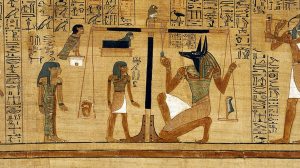
 These are fears rarely vocalised but never far from the surface. We want to live while we can, speak while we can speak and make a difference in the world while we can. We all know there would be nothing worse than leaving this world without achieving that goal we always wanted to or leaving holding onto silly grudges we had with our loved ones, instead of telling them how we really feel about them.